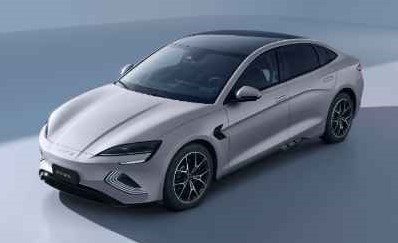
BYD, the world’s leading manufacturer of New-Energy Vehicles (NEV), has announced pricing and specifications for the 2026 SEAL – a model which builds on the technology, practicality and design of the current model, yet maintains the same starting price of £45,730 on-the-road.
The SEAL was launched in the UK in 2023, and the series of changes for 2026 aim to build on already class-leading standard equipment and powertrain specifications with an even more practicality, safety tech and contemporary design. For 2026, the new BYD SEAL receives a series of subtle enhancements to add even more appeal to its OCEAN design. A new design of 19-inch wheels lends it a more assertive stance, while buyers will now be able to benefit from an increased level of customisation thanks to three new exterior colour options.
Ruby Red, Obsidian Black and Lavender Grey join three existing shades: Polar White, Indigo Grey and Atlantis Grey. To the rear of the car, the BYD logo is now positioned prominently top and centre above the full width LED light bar, with the SEAL model designation positioned to the bottom right of the boot lid. The interior gains a sleeker appearance.
As before, the seats are trimmed in soft Nappa leather upholstery, but the headrests now sport a clean design without the BYD logo that was previously stitched onto the headrests. The centre armrest, meanwhile, no longer displays the NFC logo on previous models – but retains the functionality. Meanwhile, the SEAL becomes more versatile than ever, maximising the luggage space available within the existing 4.8-metre footprint.
The boot, accessible by a standard powered tailgate, grows in capacity from 400 litres to 485 litres, and gains a pair of tethering hooks to secure loose items. Under the bonnet, a redesigned storage area grows 19 litres larger than before, now offering 72 litres – large enough to hold charging cables, or even a carry-on suitcase. The new SEAL’s on-board technology is enhanced, boosting the already comprehensive standard equipment levels of the existing model.
The changes focus on the standard suite of assistance technology; the addition of a Driver Monitoring System, which can detect the driver’s attention on the road, complies with the latest and most stringent safety standards. Another new addition for the 2026 version is the Bluetooth key. This enables drivers to access their car through a smartphone-based keyless entry system.
As before, the BYD SEAL offers comprehensive equipment levels. The Design trim includes a standard specification taking in LED headlights with High Beam Assistant, a panoramic glass roof, a Dynaudio 12-speaker sound system, two 15-watt wireless charging trays, front seats which are electrically adjustable and feature both heating and ventilation, plus a fixed 15.6” high-definition touchscreen. The Excellence improves on this specification even further, with the addition of a head-up display.
Further to the increased standard specification of the Excellence, it also benefits from unique powertrain and chassis specifications. Its two-motor, all-wheel drive configuration develops 523bhp and 670Nm of torque, resulting in a 0-62mph time of just 3.8 seconds, while semi-adaptive suspension technology features variable frequency dampers. The Design features a single motor driving the rear wheels.
Maximum output stands at 308bhp and 360Nm of torque, which results in a 0-62mph time of 5.9 seconds. Both models are limited to a top speed of 112mph. BYD’s industry-leading blade battery – with a cobalt-free Lithium Iron-Phosphate (LFP) chemistry – remains a key distinguishing feature of the new SEAL.
Its capacity of 82.5kWh results in a WLTP range of 354 miles for the Design trim, and 323 miles for the Excellence. Rapid charging is made possible by a 150kW peak speed; a 10%-80% recharge takes 37 minutes. Prices start at £45,730 for the Design, with the Excellence priced at £48,730 – unchanged from the existing SEAL.
As with the rest of the BYD lineup, the SEAL is backed up by a six-year, 93,750-mile warranty, plus a battery cover of up to eight years or 155,350 miles.