
The 2026 Dakar Rally Saudi Arabia concluded with one of the most dramatic finishes in the event’s long history, as just two seconds separated first from second place in the bike category, after nearly 8,000km of competition across Saudi Arabia’s challenging landscape.
Luciano Benavides produced an extraordinary late charge to claim his maiden Dakar victory, overturning a deficit to beat Ricky Brabec by the narrowest of margins. The Red Bull KTM rider’s success sparked wild celebrations as the Argentinian joined his brother Kevin Benavides on the list of Dakar champions. This year’s event appeared to be heading the way of reigning champion Daniel Sanders, but his campaign was derailed by a heavy crash on Bisha that resulted in a broken collarbone.
Despite showing immense resilience to continue, momentum shifted towards his KTM team-mate Benavides, and his closest challenger came from Monster Energy Honda’s Brabec. In pursuit of his third Dakar win, the American tactically slowed on Al Henakiyah to secure a favourable starting position for the decisive run to Yanbu, a move that briefly cost him the overall lead. However, the strategy appeared to pay off, as he began the final stage with over a three-minute advantage. But with just seven kilometres remaining, a costly navigation error proved decisive.
In a stunning reversal, Benavides surged through to snatch victory by just two seconds— an incredible margin over two weeks of relentless competition. “I gave it everything from start to finish,” said Benavides.
“I never stopped dreaming and I never stopped believing. In those final kilometres, Ricky took the wrong track, and I took the right one. It was a glimmer of hope.
“I saw the opening and I went for it. I told everyone before the start that this Dakar was mine. Nine years in the Dakar and my first win.”
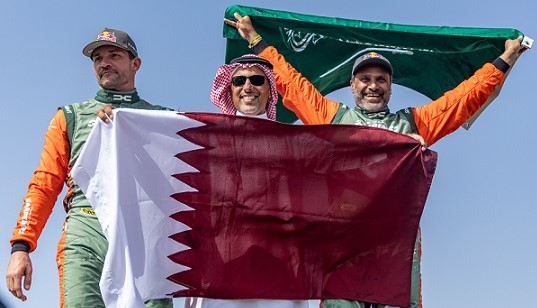
In Rally2, Slovenian Toni Mulec made a late turnaround to defeat Johnny Campbell, while Benjamin Melot claimed victory in the Original by Motul class for riders without service crews. In the Ultimate category for cars, Nasser Al-Attiyah further cemented his place among Dakar’s all-time greats, securing his sixth overall victory.
The Qatari now sits just two wins behind eight-time champion Stéphane Peterhansel, while also recording his 50th career Dakar stage victory on the penultimate day. It was a measured performance from Al-Attiyah in one of the most competitive T1 Ultimate fields in recent memory, delivering Dacia Sandriders their first Dakar win at just their second attempt. Alongside him, co-driver Fabian Lurquin made history by becoming the first Belgian navigator to win the Dakar Rally outright.
“We are so happy to win,” said the 55-year-old Qatari.
“I think we made the difference on the second day of the first marathon stage by building up a 12-minute lead. The penultimate day was also important. That’s when we knew we’d won the race.
“This is my sixth victory, but I still need to break Peterhansel’s record!” This year’s event underlined the depth of competition across the Ultimate class. In total, five different makes and nine drivers claimed victories on the 13 stages.
Al-Attiyah took decisive wins on stage six (Ha’il to Riyadh) and the penultimate stage (Al Henakiyah to Yanbu), while second-placed Nani Roma — who finished 9m42s behind — claimed victory on the final stage. Ford Raptor team-mate Mattias Ekström completed the podium, with two stage wins. Toyota’s challenge faltered despite five stage victories, as Henk Lategan suffered mechanical issues.
Meanwhile, Saudi privateer and defending champion Yazeed Al-Rajhi was forced to retire early after a series of punctures ended his challenge. In the Stock category, Defender won on their Dakar debut, successfully bringing all three D7X-Rs to the finish in Yanbu, led by Lithuanian Rokas Baciuška. A revised route for 2026, featuring marathon stages and fewer service opportunities, showcased Saudi Arabia’s extraordinary and varied terrain, delivering closely fought contests across all categories.
The route pushed competitors to their limits through vast deserts and remote sandy sections within the Kingdom. Saudi drivers once again impressed on home soil. Yasir Seaidan, partnered by co-driver Xavier Flick for Nasser Racing Team, finished second overall in the Challenger class, ending the rally 23m22s behind Spaniard Pau Navarro. Dania Akeel also produced a strong performance, finishing eighth in class and recording seven top-three stage results.
Elsewhere, American Brock Heger defended his SSV crown, with Lithuanians Vaidotas Zala winning the Truck class and Karolis Raišys the Dakar Classic driving a Land Rover. Starting and finishing at the Red Sea port city of Yanbu, the opening round of the FIA-FIM Rally-Raid World Championship once again proved to be a formidable challenge. Of the 317 vehicles that started, 247 completed the full route, underlining both the scale and toughness of the test presented by Dakar Rally Saudi Arabia.
Held under the supervision of the Ministry of Sport, organized by the Saudi Automobile and Motorcycle Federation, and promoted by the Saudi Motorsport Company, this year’s edition reflected the continued evolution of the world’s toughest endurance rally. In Yanbu, HRH Prince Khalid bin Sultan Al-Abdullah Al-Faisal, Chair of SAMF and SMC, welcomed Mohammed Ben Sulayem, President of the International Automobile Federation (FIA), for the closing of the Rally.
“Dakar Rally Saudi Arabia continues to demonstrate why the Kingdom is now firmly established as a global home for world-class motorsport,” said Prince Khalid bin Sultan Al-Abdullah Al-Faisal.
“This year’s rally delivered exceptional competition, an unforgettable finish, and was a fitting showcase of Saudi Arabia’s diverse landscapes and organizational capabilities. We are immensely proud to welcome the world’s best rally-raid competitors, teams, and officials, and to see Saudi drivers competing at such a high level on home soil. As well as a sporting challenge, Dakar is a symbol of endurance, resilience, and progress, and we look forward to building on this success in the years to come.”