

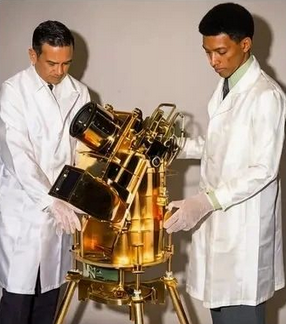
George Carruthers helped humanity see the universe in a new way, yet too few people know a Black scientist put one of the first telescopes on the Moon. George Carruthers gave science a way to see what the human eye never could.
His far ultraviolet camera and spectrograph opened a hidden universe, making it possible to study Earth’s upper atmosphere, stars, nebulae, and gases in interstellar space through wavelengths blocked from ordinary view. That achievement was not small, and it was not accidental - it came from a scientist whose work expanded humanity’s understanding of both our own planet and the wider cosmos at a time when Black brilliance in advanced science was far too often overlooked.
Carruthers developed the instrument while working at the U.S. Naval Research Laboratory, receiving a patent in 1969 for the ‘Far Ultraviolet Electrographic Camera’, a device designed to detect short-wavelength electromagnetic radiation that had remained difficult to capture with earlier tools. That patent mattered because it was more than a technical success: it was a Black inventor claiming space in one of the most demanding scientific frontiers in the country.
The power of his invention became even clearer a few years later. In 1972, astronauts on Apollo 16 deployed Carruthers’s far ultraviolet camera and spectrograph on the lunar surface, making it the first observatory placed on the Moon. That detail alone should place his name much higher in public memory - a Black scientist helping put a new scientific eye on the Moon, and that eye was built to gather information no ordinary camera could see.
The instrument was used to capture ultraviolet images and spectra of Earth’s upper atmosphere, auroras, nebulae, and star fields, and also helped scientists study interstellar hydrogen and other gases in space, giving researchers new evidence about the composition and behaviour of the universe. That is what makes Carruthers’s story so powerful from a Black perspective.
He was not simply participating in science - he was changing what science could observe at all. There is something deeply moving about that. Black history is full of people who had to create new tools just to make the world acknowledge what had always been there.
George Carruthers did that in the language of optics, physics, and engineering. He helped scientists see an invisible layer of reality, and in doing so, he joined a long Black tradition of turning insight into transformation, with his work also reminding us that Black achievement cannot be boxed into one narrow category. Carruthers was an inventor, an astrophysicist, and an engineer whose work connected laboratory precision to space exploration at the highest level. The public often remembers rockets, astronauts, and moonwalks first - but behind those headline moments were minds like his, shaping the instruments that made discovery possible.