

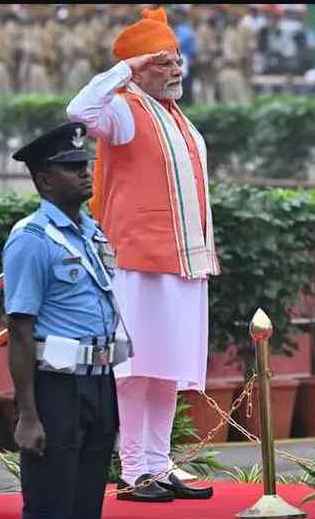
Celebrated annually on 15 August as a public holiday, this year sees India celebrate its 79th Independence Day - commemorating the nation's struggle for independence from over 200 years of British colonial rule.
It marks the day in time when the Indian Independence Act 1947 came into effect, which meant transferring legislative sovereignty to the Indian Constituent Assembly. It also marks the time when the South East nation attained full independence following movements which were noted for its non-violent resistance and civil disobedience - led by the Indian National Congress under its leader Mahatma Gandhi.
Defiant in his speech, Prime Minister Narendra Modi (pic) said: "Self-reliance is the foundation of developed India and freedom becomes meaningless if someone becomes too dependent on others.
“We remain dependent on many countries to meet our energy needs, but to build a truly self-reliant India, we must achieve energy independence.” Further in his speech, he went on: “India has established a ‘new normal,’ hinting that New Delhi would – for one - continue its unilateral suspension of the Indus Water Treaty with Pakistan.
The treaty allows sharing the roughly 2,897 kilometre (1800 mile) river, a lifeline for both countries. India first suspended it in reaction to the recent Kashmir attack. "Rivers from India were irrigating the lands of enemies while my country's farmers and land faced a deficiency of water," Modi said.
"India has now decided that blood and water will not flow together." And, on a business level, the Indian government also said that it will slash the consumption tax it charges consumers and businesses by October.
He also said that the goods and services tax would be reformed, and taxes lowered by Diwali, the Hindu festival of lights, set to be celebrated in October this year. "This Diwali, I am going to make it a double Diwali for you. Over the past eight years, we have undertaken a major reform in goods and services tax,” he said.
“We are bringing next-generation GST reforms that will reduce the tax burden across the country." The final decision will be taken by the GST (goods and services taxes) Council, which is chaired by the finance minister and has all the state's finance ministers as members, the official said.
This came hours after the PM announced sweeping tax reforms to boost the economy in the face of a trade conflict with the United States. The federal government will propose a two-rate structure of 5% and 18%, doing away with the 12% and 28% tax that was imposed on some items, said the government official, who declined to be named as the plans are still private.